Awe Experience Scale (AWE-S) Journal and Interactive Assessment Tool
Free for individuals and researchers
Awe Experience Scale (AWE-S)
A secure, research-based interactive free tool for documenting, measuring, and reflecting on experiences of awe.
Awe Experience Scale (AWE-S) Journal and Interactive Assessment Tool
Free for individuals and researchers
A secure, research-based interactive free tool for documenting, measuring, and reflecting on experiences of awe.
The AWE-S Journal and Interactive Assessment Tool is a secure, private interactive platform that combines personal journaling with validated psychological assessment. It allows you to document your experiences of awe, complete the Awe Experience Scale (AWE-S) questionnaire, and receive a research-informed multidimensional profile showing how your experience expressed itself across six validated dimensions of awe.
Each journal entry captures one experience: your narrative, your responses to the 30 AWE-S items, and your resulting Awe Profile visualized through the Zamin AWE-S Diagram. You can log multiple experiences over time and return to them whenever you wish. This tool is not a diagnostic instrument, a therapeutic assessment, or a judgment about the value or meaning of your experience. Awe can be deeply significant in many ways. The purpose of this journal is reflection, understanding, and careful description; not classification for its own sake.
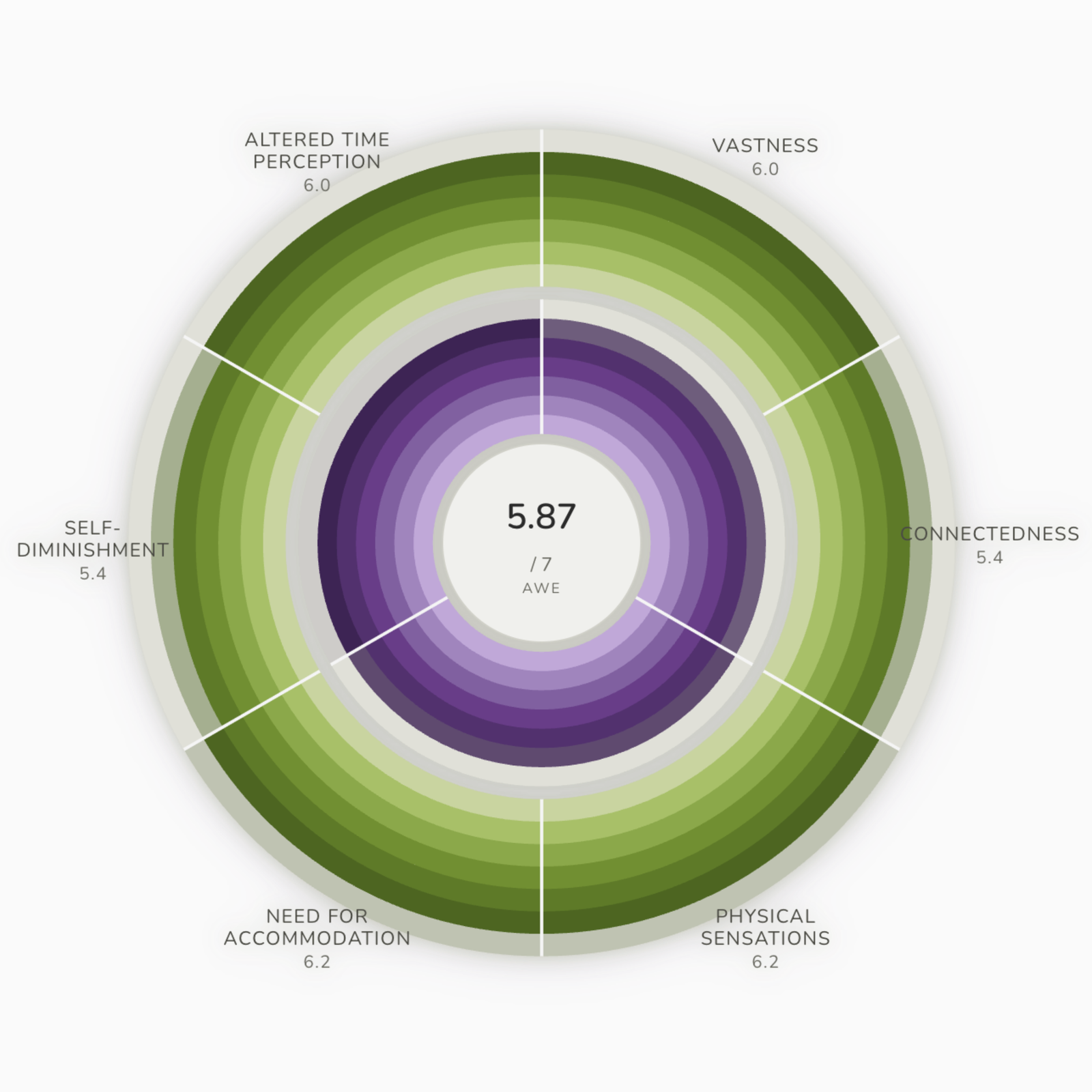
A novel method for visualizing the multidimensional structure of awe
The Zamin AWE-S Diagram is an original visualization method developed as part of the AWE-S Journal and Interactive Assessment Tool. It presents the six validated dimensions of the Awe Experience Scale and three interpretive meta-clusters simultaneously within a single circular form: two concentric rings, each divided into equal sections.
Each section of the outer ring corresponds to one of the six AWE-S factors: Vastness, Connectedness, Self-Diminishment, Need for Accommodation, Physical Sensations, and Altered Time Perception. The inner ring shows three meta-clusters derived from awe research: Expansive Awe, Challenging Awe, and Embodied Awe. Within each section, seven concentric bands represent the seven points of the scale. Bands fill from the inside outward in proportion to the score: a score of 4 out of 7 fills the innermost four bands, leaving the outer three unlit.
The result is an immediate, intuitive portrait of an awe experience: where it was intense, where it was subdued, and how the six dimensions relate to each other and to the three broader clusters. Each diagram is unique to the experience that generated it.
© Zamin AWE-S Diagram. Proprietary visualization method. All rights reserved.The MEQ-30 Journal and Interactive Assessment Tool is a secure, private space designed to help you reflect on and understand your own experiences using the Mystical Experience Questionnaire (MEQ-30). It allows you to record experiences, complete the questionnaire, and view a research-informed interpretation of how your experience aligns with four empirically derived dimensions of mystical experience. Like the AWE-S tool, it is not a diagnostic instrument or a judgment about the value or meaning of your experience.
A question worth asking
Awe is one of the most studied yet least understood emotions in contemporary psychology. It arises when we encounter something so vast, physically, conceptually, or spiritually, that it urges us to alter our very understanding of the world and our place in it.
Research has shown that awe is not a single feeling but a multidimensional emotional state. It can be expansive and connecting, or disorienting and challenging. It can arrive through nature, music, a powerful idea, or an encounter with something that defies ordinary explanation. The Awe Experience Scale (AWE-S) was developed by David Yaden, Dacher Keltner, and colleagues to capture this complexity. It measures six empirically derived dimensions of awe, not to classify your experience, but to reveal its structure.
Awe Experience Scale
The AWE-S evaluates experiences across six dimensions that repeatedly appear in psychological research on awe:
The perception of something immense, physically, conceptually, or spiritually, that felt much larger than yourself.
A sense of unity, oneness, or deep connection with living things, humanity, or existence itself.
A reduced sense of self; the ordinary boundaries of identity felt smaller or less central.
The experience challenged your existing understanding; it was difficult to fully process or integrate.
The body responded: through chills, goosebumps, a dropped jaw, or widened eyes.
Time shifted; moments felt longer, slower, or different from ordinary experience.
In December 2024, a team of researchers published a peer-reviewed validation study extending the original Awe Experience Scale into a shorter, 12-item version designed specifically for psychedelic contexts. Across six studies and thousands of participants, the research confirmed that this short form, the AWE-SF, holds up just as reliably as the full 30-item scale while reducing the burden on participants.
Study 1: Replicated the AWE-S's six-factor structure (time, self-loss, connection, vastness, physical sensations, accommodation) in 1,416 people describing a positive psychedelic experience. Study 2: Selected the top 2 items per factor to build the 12-item AWE-SF. Study 3: Confirmed that same 12-item structure held up in a larger, more diverse sample (4,745 people). Study 4: Showed AWE-SF scores correlated with better well-being and lower depression/anxiety. Study 5: Compared the full AWE-S to the AWE-SF head-to-head; both performed similarly against emotion and personality measures. Study 6: Extended validity testing to mystical experience (MEQ), challenging experience (CEQ), life satisfaction, and psychological richness.
The findings also revealed a meaningful pattern within the six dimensions of awe. Connection and vastness were closely tied to positive outcomes, including mystical-type experiences and long-term well-being, while self-loss and accommodation were more closely tied to challenging experiences. This distinction helps explain why awe during a psychedelic experience can feel so different from person to person, and it directly informs how our tools measure and interpret these dimensions.
Research has identified awe as a central mechanism underlying the effects of psychedelic-assisted therapy. Studies using psilocybin and other classical psychedelics consistently report experiences characterized by vastness, connectedness, and self-transcendence, the core features of awe. Peter Hendricks (2018) proposed that awe is the primary psychological mechanism through which psychedelic-occasioned mystical experiences produce lasting therapeutic benefit. Subsequent research, including work conducted with Johns Hopkins University, has confirmed that the facets of connectedness and vastness are most strongly associated with positive emotional outcomes and mystical-type experiences, while self-diminishment and need for accommodation are more closely linked to challenging aspects of the experience.
Awe has been shown to expand perception of time, reduce self-focused thinking, increase prosocial behavior, and support wellbeing. It is associated with humility, openness to experience, and, in some research contexts, reduced markers of inflammation. Dacher Keltner has described awe as the 'everyperson's spiritual experience', available across cultures, belief systems, and life circumstances. The AWE-S provides a validated, structured way to examine how awe manifests in any given experience, without requiring a particular interpretation of what that experience means.
The references listed here are provided for contextual and scholarly transparency and do not imply endorsement of any particular interpretation, practice, or outcome.
Keltner, D., & Haidt, J. (2003). Approaching awe, a moral, spiritual, and aesthetic emotion. Cognition & Emotion, 17(2), 297–314.
→ Foundational theoretical account defining awe through vastness and need for accommodation.Yaden, D. B., et al. (2019). The development of the Awe Experience Scale (AWE-S): A multifactorial measure for a complex emotion. Journal of Positive Psychology, 14(4), 474–488.
→ Development and validation of the 30-item AWE-S across two large samples.Graziosi, M., Rohde, J. S., Lake, S., Lucas, P., Kaufman, S. B., & Yaden, D. B. (2024). Developing a short form of the Awe Experience Scale (AWE-SF) in psychedelic samples. PLOS ONE, 19(12): e0314469.
→ Six-study validation of the 12-item AWE-SF across psychedelic samples; confirms six-factor structure and predictive validity for wellbeing and mystical experience outcomes.Hendricks, P. S. (2018). Awe: a putative mechanism underlying the effects of classic psychedelic-assisted psychotherapy. International Review of Psychiatry, 30(4), 331–342.
→ Proposes awe as the primary psychological mechanism of psychedelic-assisted therapy.Rudd, M., Vohs, K. D., & Aaker, J. (2012). Awe expands people's perception of time, alters decision making, and enhances well-being. Psychological Science, 23(10), 1130–1136.
→ Demonstrates awe's effect on time perception and wellbeing.The AWE-S Journal and Interactive Assessment Tool is an independent platform built to make the validated Awe Experience Scale accessible for personal reflection and research. Contributions help maintain the platform and support the continued development of tools for researchers and individuals exploring experiences of awe and consciousness.
Support This Project